
Author Mohamed Sabreen
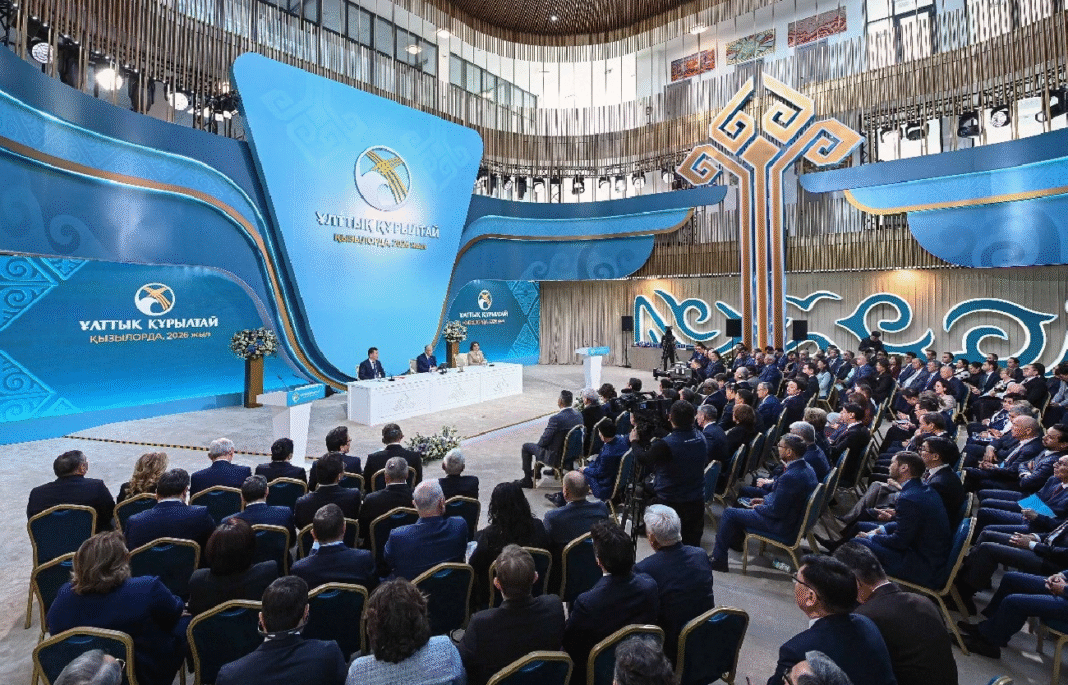
Kazakhstan’s parliamentary elections have opened a new chapter in the country’s political development. The elections to the new 145-member Kurultai, established under the Constitution that came into force on 1 July, mark the first test of a substantially redesigned political architecture. President Kassym-Jomart Tokayev has presented the constitutional changes as the beginning of a new stage in Kazakhstan’s political development, with a streamlined unicameral legislature and new arrangements intended to improve the balance between state institutions.
Yet the importance of the elections should not obscure the larger questions waiting for Kazakhstan. The new political chapter begins at a moment when the country faces a complex combination of domestic, economic and geopolitical challenges. Some of these questions concern the future of political reform and the relationship between the state and society. Others are more directly linked to Kazakhstan’s exceptionally sensitive position between Russia, China and the West.
For years, Astana has pursued what has become known as a “multi-vector” foreign policy. It has maintained close relations with Russia, deepened its strategic and economic partnership with China, and simultaneously expanded ties with the European Union, the United States, Türkiye and other international partners. This approach has served Kazakhstan well. It allowed the country to benefit from its geography rather than become its prisoner.
But the international environment is changing. Competition between the major powers is no longer confined to military alliances or diplomatic influence. It increasingly involves technology, artificial intelligence, critical minerals, energy infrastructure, digital networks and supply chains. As these areas become strategic assets, the space for countries to maintain equally close relations with competing powers may become narrower.
A recent study by the Washington-based Center for Strategic and International Studies (CSIS), entitled The Infrastructure Trap: What Beijing Has Learned from Moscow’s Playbook in Central Asia, published on 16 April 2026, examines the vulnerabilities created by infrastructure dependence in Central Asia. The study, by Leah Kieff, argues that Chinese infrastructure investment is creating forms of dependency that resemble some of the structural dependencies inherited from the Soviet period, while also noting that Central Asian countries continue to have room to preserve leverage if they can diversify their partnerships and strengthen their institutions.
The argument is particularly relevant to Kazakhstan. Infrastructure is never simply infrastructure when it determines how a country exports its resources, receives technology or connects to international markets. Pipelines, railways, ports, electricity networks and digital systems can become instruments of strategic influence.
Energy provides perhaps the clearest example.
Kazakhstan is one of the world’s major oil producers, yet its landlocked geography makes export routes a strategic vulnerability. Reuters reported in July that the Caspian Pipeline Consortium carries more than 80 per cent of Kazakhstan’s oil exports, primarily from the giant Tengiz field, to the Russian Black Sea port of Novorossiysk. A temporary closure of the export terminal following drone attacks caused Kazakhstan’s oil output to fall by more than half, dramatically illustrating the risks associated with dependence on a single major export route.
This does not mean that Kazakhstan can simply abandon the Russian route. It cannot. The issue is diversification.
The development of alternative routes through the Caspian Sea, Azerbaijan and Türkiye — particularly the Middle Corridor linking Central Asia with Europe — has therefore acquired strategic importance. For Astana, transport diversification is not only about trade efficiency. It is about preserving political room for manoeuvre.
The same logic applies to China.
China has become one of Kazakhstan’s most important economic partners. The Belt and Road Initiative was announced by President Xi Jinping during his visit to Kazakhstan in 2013, underlining the country’s central geographical position between China and Europe. Chinese investment in infrastructure, transport, energy and industry offers Kazakhstan opportunities that are difficult to replace.
But the closer the economic relationship becomes, the more important the question of balance becomes. Kazakhstan wants Chinese investment without excessive dependence; Chinese technology without technological vulnerability; and access to Chinese markets without surrendering strategic autonomy.
This is becoming even more significant as critical minerals and rare earth elements move to the centre of global competition. Kazakhstan possesses substantial mineral resources, including uranium and other strategic materials, making it increasingly attractive to the major economic powers. Yet transforming these resources into economic strength requires capital, technology and access to global markets.
Those assets are not concentrated in one country.
Western companies possess important technological and financial capabilities. China has enormous manufacturing capacity and growing expertise in strategic minerals and infrastructure. Russia remains deeply embedded in regional transport, energy and security networks. Kazakhstan therefore has an interest in maintaining relations with all three rather than becoming dependent on any one of them.
This explains why the debate over the future of Kazakhstan’s multi-vector policy is becoming increasingly important.
The country’s relationship with Russia is perhaps the most delicate part of the equation. Geography cannot be negotiated away. Kazakhstan shares the world’s longest continuous land border with Russia and remains linked to Moscow through economic, security and institutional arrangements. At the same time, the war in Ukraine has encouraged Astana to place greater emphasis on sovereignty, territorial integrity and an independent foreign policy.
Tokayev has repeatedly sought to maintain this balance. Kazakhstan has not joined Western sanctions against Russia, but neither has it endorsed Moscow’s territorial claims in Ukraine. Astana has instead positioned itself as a supporter of dialogue and negotiation.
This balancing policy reflects a broader principle: Kazakhstan does not want to replace one dependency with another.
The domestic dimension is equally important.
The new Constitution has reorganised the political system around a unicameral Kurultai, with 145 deputies elected under a proportional representation system. It also provides for a vice-presidency and establishes new institutional arrangements. The constitutional reform was therefore more than an electoral exercise; it was an attempt to redefine the relationship between the presidency, legislature and other state institutions.
The sensitive domestic question now is whether these institutional reforms will translate into greater political participation and stronger checks and balances, or whether they will primarily consolidate a presidential system under a new constitutional framework.
This question matters because political stability is one of Kazakhstan’s principal strategic assets. The country has experienced rapid economic transformation, but it also faces inflationary pressures, social expectations and the need to diversify an economy still heavily dependent on natural resources.
The success of the new political architecture will therefore be judged not only by the composition of the Kurultai, but by its ability to address economic and social priorities and to give citizens a greater sense that political reform has tangible consequences.
For Tokayev, the challenge is to ensure that reform strengthens the legitimacy of the state without producing instability. For Kazakhstan as a whole, the challenge is to combine political stability with institutional development.
The external challenge is arguably even more difficult.
Washington, Beijing and Moscow increasingly see technology, infrastructure and economic relationships through a strategic lens. The recent debate over competing American and Chinese initiatives in artificial intelligence is an indication of where this rivalry may be heading. If technology becomes another arena of bloc competition, countries such as Kazakhstan may find it increasingly difficult to participate simultaneously in competing systems.
This is why the question facing Astana may not ultimately be whether to choose Russia, China or the West. It may instead be how to maintain enough strategic autonomy that it does not have to make such a choice.
That will require a more diversified economic base, alternative energy and transport routes, broader investment partnerships and greater technological capacity at home. It will also require stronger regional cooperation among the Central Asian states themselves. No individual country in the region can easily offset the weight of Russia or China, but a more integrated Central Asia could increase its collective bargaining power.
Kazakhstan’s geography, in this sense, can be either a vulnerability or an advantage.
Its location between Russia, China and Europe has exposed it to competing pressures. But the same location places Kazakhstan at the centre of emerging trade corridors, energy networks and Eurasian connectivity. If Astana can transform its geography into connectivity rather than dependence, it can strengthen its position as a middle power.
The elections have therefore opened a new political chapter, but they have not answered the most difficult questions. Those questions are only beginning.
At home, Kazakhstan must demonstrate that constitutional reform can produce effective institutions, political stability and economic opportunity. Abroad, it must preserve its multi-vector diplomacy at a time when the space between competing powers is becoming increasingly narrow.
The country’s greatest strategic objective may consequently be neither alignment nor neutrality, but strategic autonomy.
For Kazakhstan, the most important choice may be the choice not to be forced into one.

