
By Amr Yehia
Kazakhstan plays a pivotal role as a moderate and centrist Islamic power in the heart of Central Asia. Although Islam entered its lands as early as the 8th century AD, the state has chosen since its independence to present a unique model that combines tolerant Islamic traditions with openness to other cultures. Astana works to consolidate the concept of “moderate Islam” through its religious and academic institutions, and through its ongoing hosting of interfaith dialogue conferences and gatherings of traditional leaders. This has made it an influential voice in calling for tolerance and rejecting extremism both within the region and beyond.
Today, Astana is a key hub for Islamic and cultural tourism in Central Asia. The city, which blends architectural modernity with historical identity, is home to prominent mosques, Islamic centers, and archaeological sites that reflect the depth of Islamic civilization in the Kazakh steppes. Astana also attracts thousands of visitors annually to its conferences and exhibitions that focus on “moderate tourism” and enlightened thought, leveraging its position as a bridge connecting East and West, and its rich Islamic heritage that makes it an appealing destination for researchers and tourists seeking a balanced spiritual and cultural experience.
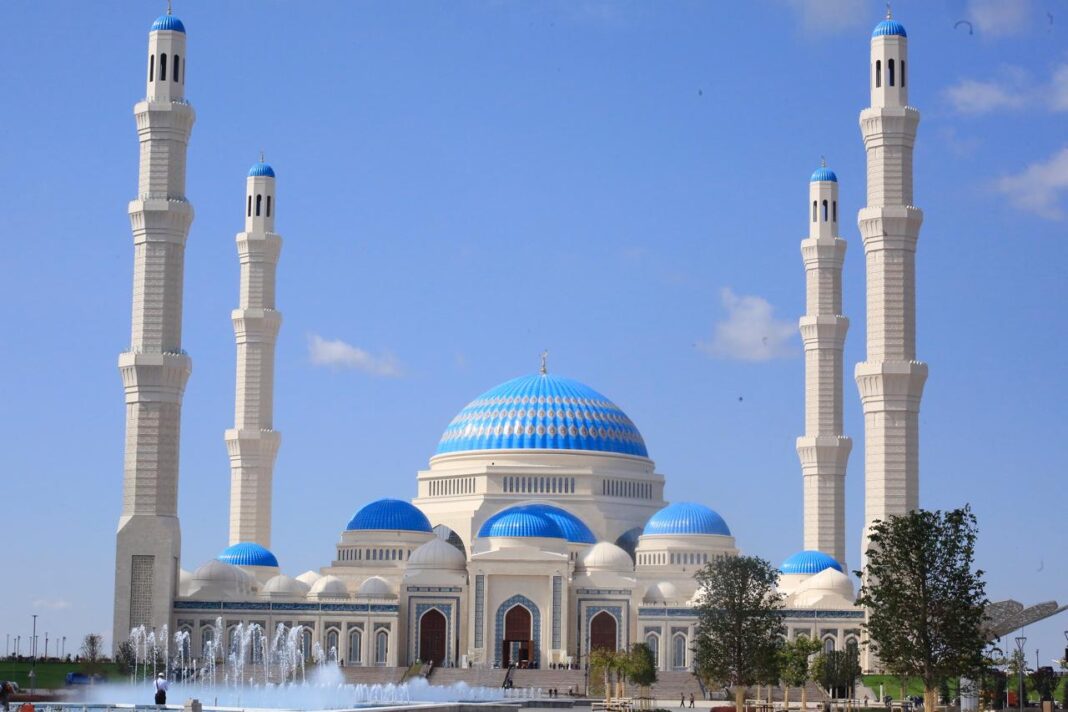
Among the most prominent Islamic landmarks in the capital Astana, rising from the heart of the vast Kazakh steppes, is the “Grand Astana Mosque.” It is not only one of the largest mosques in the world, with a total capacity of 235,000 worshippers, but also a civilizational symbol that restores to Central Asia its historic role as a crossroads of cultures and a beacon of intellectual radiance on the ancient Silk Road.
The architecture of this edifice, designed by architect Aisha Jul Yerkin and inaugurated in 2022, combines classical Islamic aesthetics with Kazakh national ornamentation. Its enchanting blue dome rises to 83.2 meters and is surrounded by 72 smaller domes in a unique geometric formation symbolizing unity and solidarity. Its walls are adorned with Quranic verses written in the longest hand-drawn Arabic calligraphy strip in the world, extending for about 198 meters with the masterful artistry of Kazakh calligrapher Asilbek Baiuzakov.
Inside, grandeur meets exquisite precision: from the towering African “Iroko” door at 12.56 meters high, to the largest hand-woven New Zealand wool carpet with an area of 16,000 square meters, to a giant crystal chandelier weighing 22 tons at the center of the hall, made up of millions of shimmering pieces that reflect light in seven enchanting colors. One of its four towering minarets (130 meters high) is equipped as a “tourist tower” with an elevator, offering visitors the opportunity to explore the capital Astana from above. Thus it becomes a comprehensive destination linking worship, tourism, and cultural diplomacy, reinforcing Kazakhstan’s position as a bridge of tolerance and civilizational communication in the heart of the Asian continent.
The significance of the mosque goes beyond architectural beauty. It plays a pivotal social and cultural role in Kazakhstan and Central Asia. It is not limited to prayer halls, but also includes an integrated cultural center with conference and seminar halls, a distinguished Islamic museum, a library, marriage halls, and a TV studio. It also features an underground tunnel for public buses to facilitate visitor access during the harsh winter.

